The Divine Within by Aldous Huxley
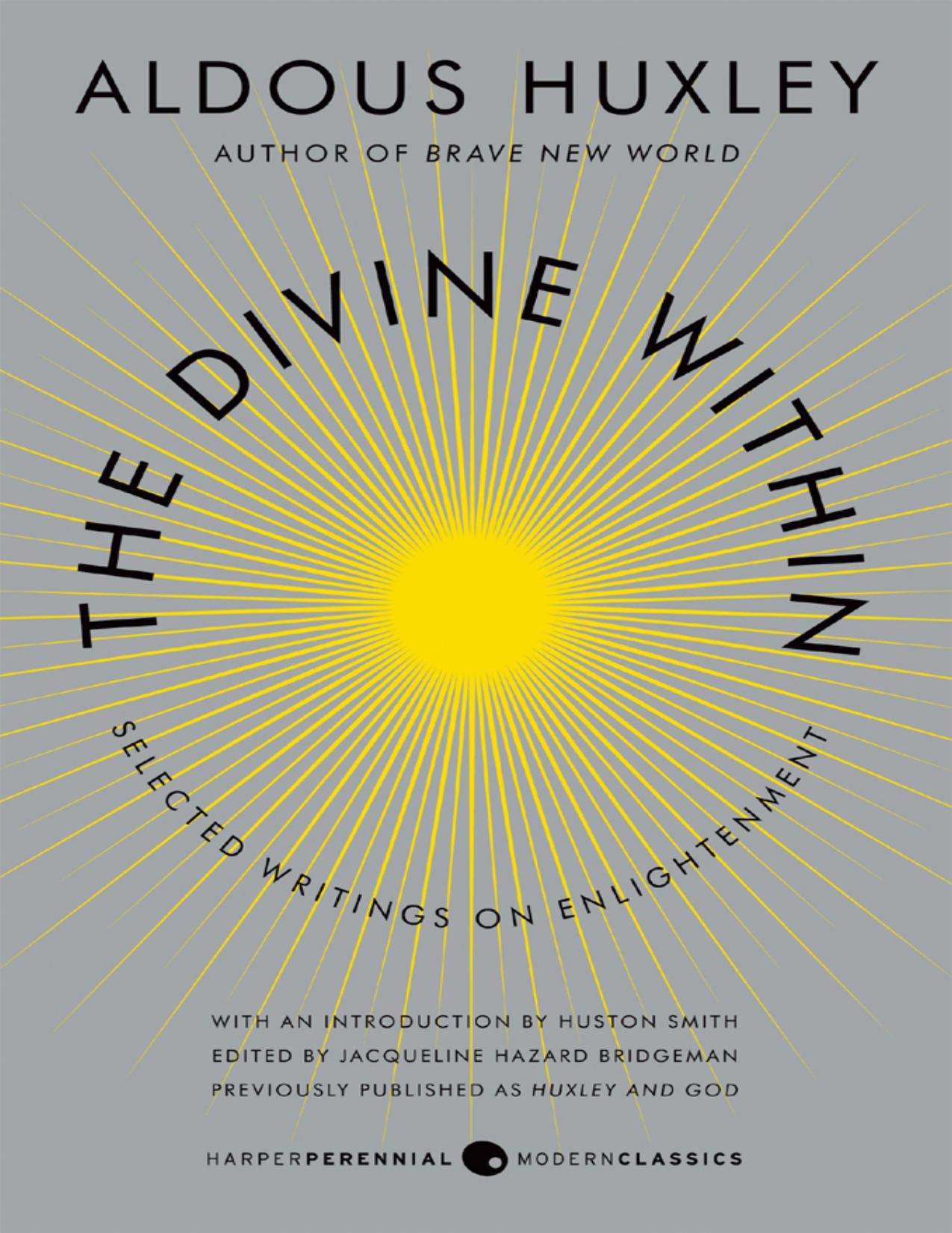
Author:Aldous Huxley
Language: eng
Format: epub, mobi, azw3, pdf
Publisher: HarperCollins
Published: 2013-05-18T04:00:00+00:00
17
DISTRACTIONS—II
In an earlier article I gave some account of the psychological nature of distractions and of their significance as obstacles in the path of those who seek to attain enlightenment. In the paragraphs which follow, I shall describe some of the methods which have been found useful in overcoming these obstacles, in circumventing the tricks of the imbecile whom we carry about with us as a secondary personality.
Distractions afflict us not only when we are attempting formal meditation or contemplation, but also and even more dangerously in the course of our active, everyday life. Many of those who undertake spiritual exercises, whether yogic or Christian, tend all too frequently to confine their efforts at concentrating the mind strictly to business hours—that is to say, to the hours they actually spend in meditation. They forget that it is possible for a man or woman to achieve, during meditation, a high degree of mental concentration and even a kind of subjectively satisfying pseudo-ecstasy, while remaining at bottom an unregenerate ego. It is not an uncommon thing to meet with people who spend hours of each day doing spiritual exercises and who, in the intervals, display as much spite, prejudice, jealousy, greed, and silliness as the most “unspiritual” of their neighbors. The reason for this is that such people make no effort to adapt to the exigencies of ordinary life those practices which they make use of during their times of formal meditation. This is, of course, not at all surprising. It is much easier to catch a glimpse of reality under the perfect conditions of formal meditation than to “practice the presence of God” in the midst of the boredoms, annoyances, and constant temptations of family and professional life. What the English mystic, Benet Fitch, calls “active annihilation” or the sinking of the self in God at every moment of the day, is much harder to achieve than “passive annihilation” in mental prayer. The difference between the two forms of self-annihiliation is analogous to the difference between scientific work under laboratory conditions and scientific work in the field. As every scientist knows, a great gulf separates the achievement of results in the laboratory and the application of one’s discoveries to the untidy and disconcerting world outside its walls. Laboratory work and work in the field are equally necessary in science. Analogously, in the practice of the unitive life, the laboratory work of formal meditation must be supplemented by what may be called “applied mysticism” during the hours of everyday activity. For this reason I propose to divide this article into two sections, the first dealing with distractions in times of recollection, the second with the obscuring and obstructive imbecilities of daily life.
All teachers of the art of mental prayer concur in advising their pupils never to struggle against the distractions which arise in the mind during recollection. The reason for this is simple. “The more a man operates, the more he is and exists. And the more he is and exists, the less God is and exists within him.
Download
The Divine Within by Aldous Huxley.mobi
The Divine Within by Aldous Huxley.azw3
The Divine Within by Aldous Huxley.pdf
This site does not store any files on its server. We only index and link to content provided by other sites. Please contact the content providers to delete copyright contents if any and email us, we'll remove relevant links or contents immediately.
| Anthropology | Archaeology |
| Philosophy | Politics & Government |
| Social Sciences | Sociology |
| Women's Studies |
The remains of the day by Kazuo Ishiguro(8999)
Tools of Titans by Timothy Ferriss(8393)
Giovanni's Room by James Baldwin(7346)
The Black Swan by Nassim Nicholas Taleb(7129)
Inner Engineering: A Yogi's Guide to Joy by Sadhguru(6793)
The Way of Zen by Alan W. Watts(6614)
The Power of Now: A Guide to Spiritual Enlightenment by Eckhart Tolle(5781)
Asking the Right Questions: A Guide to Critical Thinking by M. Neil Browne & Stuart M. Keeley(5775)
The Six Wives Of Henry VIII (WOMEN IN HISTORY) by Fraser Antonia(5515)
Astrophysics for People in a Hurry by Neil DeGrasse Tyson(5189)
Housekeeping by Marilynne Robinson(4447)
12 Rules for Life by Jordan B. Peterson(4304)
Ikigai by Héctor García & Francesc Miralles(4274)
Double Down (Diary of a Wimpy Kid Book 11) by Jeff Kinney(4271)
The Ethical Slut by Janet W. Hardy(4251)
Skin in the Game by Nassim Nicholas Taleb(4248)
The Art of Happiness by The Dalai Lama(4130)
Skin in the Game: Hidden Asymmetries in Daily Life by Nassim Nicholas Taleb(4006)
Walking by Henry David Thoreau(3962)
